

Table of Contents (विषयसूची)
- 🌍 What is the G20?
- 🇮🇳 The 2023 G20 New Delhi Summit: A Landmark Event
- 🤝 Key Takeaway 1: Welcoming the African Union
- 📜 Key Takeaway 2: The New Delhi Leaders’ Declaration
- 🌱 Key Takeaway 3: Focus on Sustainable Development and Climate Action
- 💰 Key Takeaway 4: Navigating Global Economic Challenges
- 💻 Key Takeaway 5: Digital Public Infrastructure and Technological Transformation
- 🌟 India’s G20 Presidency: A Resounding Success
- ➡️ Looking Ahead: The G20 Troika and Brazil’s Presidency
- 🎓 Why Should You, as a Student, Care About the G20?
- ✨ Conclusion: The G20’s Enduring Relevance
What is the G20? (G20 क्या है?)
The Premier Global Forum (प्रमुख वैश्विक मंच)
Ever wondered where the world’s most powerful leaders meet to discuss the global economy? That place is the G20 Summit! 🏛️ The Group of Twenty, or G20, is the premier international forum for economic cooperation. It brings together leaders from 19 of the world’s largest economies plus the European Union and, most recently, the African Union. Think of it as the ultimate strategy meeting for managing the world’s financial health and addressing pressing global challenges.
Who are the Members? (सदस्य कौन हैं?)
The G20 is a powerhouse. Its members represent about 85% of the global GDP, over 75% of global trade, and roughly two-thirds of the world’s population. This membership includes a mix of both industrialized and emerging economies, ensuring a diverse range of voices. The countries are Argentina, Australia, Brazil, Canada, China, France, Germany, India, Indonesia, Italy, Japan, Republic of Korea, Mexico, Russia, Saudi Arabia, South Africa, Turkey, the UK, and the US. This wide representation makes G20 decisions truly global in scope. 🌍
Its Core Mission (इसका मुख्य मिशन)
Initially formed in 1999 to discuss international financial stability, the G20’s agenda has expanded significantly. Today, it tackles a broad spectrum of issues beyond just finance. These include climate change, sustainable development, health, agriculture, and anti-corruption. The main goal of the G20 is to foster strong, sustainable, balanced, and inclusive growth across the globe. It’s all about teamwork to create a more prosperous and stable future for everyone. 🤝
The 2023 G20 New Delhi Summit: A Landmark Event (2023 जी20 नई दिल्ली शिखर सम्मेलन: एक ऐतिहासिक घटना)
A Historic First for India (भारत के लिए एक ऐतिहासिक पहल)
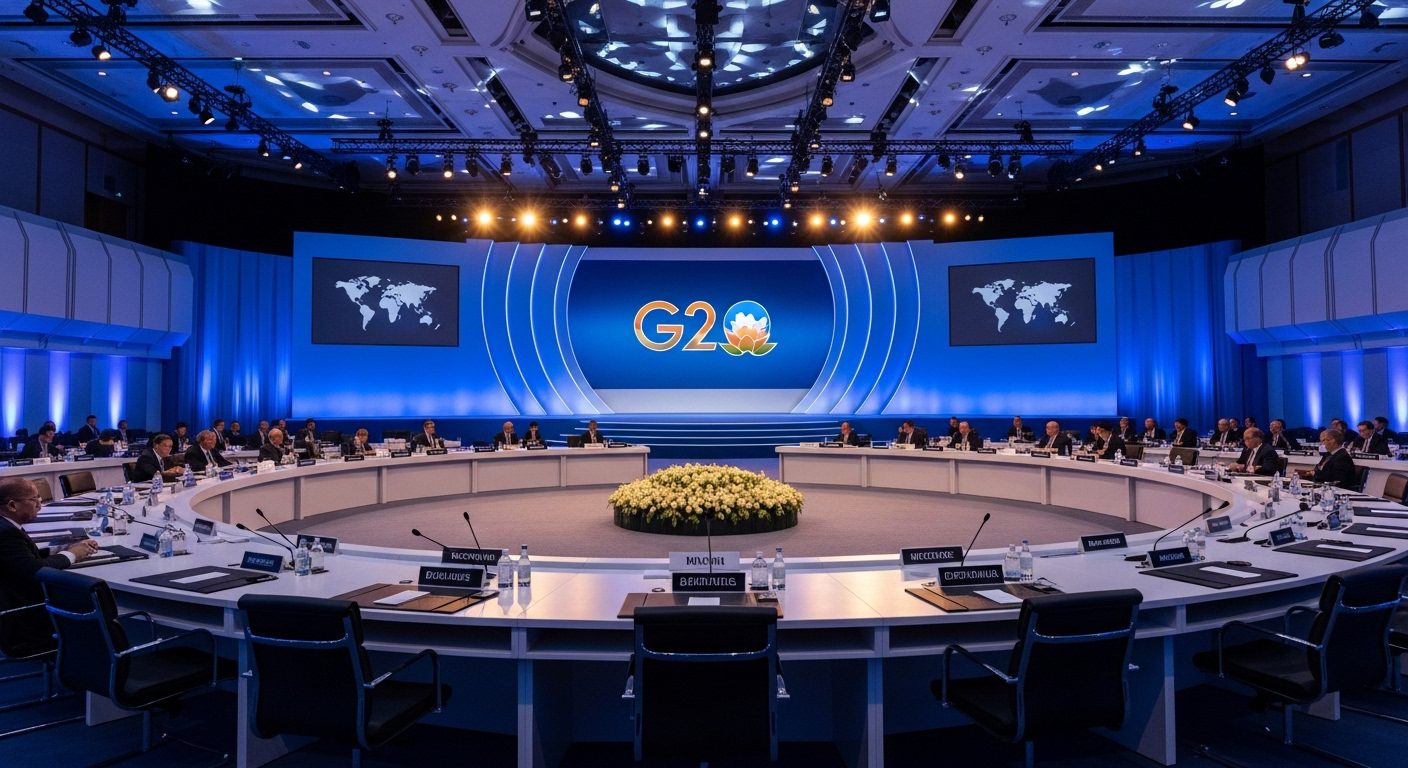
The 18th G20 Heads of State and Government Summit, held in New Delhi, India, on September 9-10, 2023, was a moment of immense pride and significance. 🇮🇳 For the first time, India held the G20 Presidency, steering the global conversation under the theme “Vasudhaiva Kutumbakam” or “One Earth, One Family, One Future.” This theme, derived from ancient Sanskrit text, beautifully encapsulated India’s vision of an interconnected and harmonious world.
Setting the Stage for Global Dialogue (वैश्विक संवाद के लिए मंच तैयार करना)
The summit took place at the state-of-the-art Bharat Mandapam International Exhibition-Convention Centre in New Delhi. It wasn’t just a two-day event; it was the culmination of a year-long series of meetings held across India, involving ministers, government officials, and civil society. These preparatory discussions laid the groundwork for the key decisions made by the leaders, making the G20 process more inclusive and comprehensive than ever before. 🗣️
Key Takeaway 1: Welcoming the African Union (मुख्य निष्कर्ष 1: अफ्रीकी संघ का स्वागत)
A Monumental Decision (एक स्मारकीय निर्णय)
Perhaps the most historic outcome of the New Delhi Summit was the inclusion of the African Union (AU) as a permanent member of the G20. This was a massive step towards making the group more representative and inclusive. The African Union, a continental body consisting of 55 member states, now sits at the same table as other major economic powers, giving a powerful voice to the aspirations and concerns of the African continent. 🎉
Why This Matters (यह क्यों मायने रखता है)
Africa is a continent with a young population, vast resources, and immense potential for growth. By including the AU, the G20 acknowledges that global challenges cannot be solved without Africa’s participation. This move amplifies the voice of the *वैश्विक दक्षिण* (Global South) and ensures that African perspectives are central to discussions on issues like economic development, climate change, and global health. It truly makes the G20 a more complete global forum.
Key Takeaway 2: The New Delhi Leaders’ Declaration (मुख्य निष्कर्ष 2: नई दिल्ली नेताओं की घोषणा)
Achieving Unanimous Consensus (सर्वसम्मत सहमति प्राप्त करना)
In a world marked by deep geopolitical divisions, the adoption of the New Delhi Leaders’ Declaration with 100% consensus was a major diplomatic victory. 📜 This document, a comprehensive roadmap for future action, was agreed upon by all members. It demonstrated that despite differences, world leaders can come together to find common ground on critical issues affecting humanity, showcasing the power of *अंतर्राष्ट्रीय सहयोग* (international cooperation).
Core Pillars of the Declaration (घोषणा के मुख्य स्तंभ)
The declaration covered a wide range of topics, reinforcing the G20’s commitment to strong, sustainable, balanced, and inclusive growth. It addressed crucial areas such as accelerating progress on Sustainable Development Goals (SDGs), promoting green development for a sustainable future, reforming multilateral institutions for the 21st century, and harnessing technological transformation and digital public infrastructure. Each point reflects a shared vision for a better world. 💡
Key Takeaway 3: Focus on Sustainable Development and Climate Action (मुख्य निष्कर्ष 3: सतत विकास और जलवायु कार्रवाई पर ध्यान)
Accelerating the SDGs (एसडीजी में तेजी लाना)
The summit placed a huge emphasis on the *सतत विकास लक्ष्य* (Sustainable Development Goals), or SDGs. Leaders acknowledged that progress on these 17 goals—which aim to end poverty, protect the planet, and ensure prosperity for all—had slowed. The G20 Action Plan endorsed in the declaration is designed to speed up progress, focusing on areas like health, education, and gender equality to get the world back on track for the 2030 Agenda. 🎯
The Green Development Pact (हरित विकास समझौता)
A key component of the declaration was the G20 Green Development Pact. This is a comprehensive strategy to tackle the challenges of climate change. It emphasizes the need for large-scale financing to support developing countries in their transition to low-carbon economies. The pact calls for a tripling of global renewable energy capacity by 2030 and highlights the importance of sustainable lifestyles, circular economy principles, and protecting our oceans. ♻️
Commitments on Climate Finance (जलवायु वित्त पर प्रतिबद्धताएँ)
Money talks, especially when it comes to climate action. The leaders reiterated the importance of mobilizing trillions of dollars for climate action. They urged developed countries to fulfill their commitment to provide $100 billion annually for the climate needs of developing nations. The declaration also focused on making *जलवायु वित्त* (climate finance) more accessible and affordable, which is crucial for enabling a global green transition. 💸
Key Takeaway 4: Navigating Global Economic Challenges (मुख्य निष्कर्ष 4: वैश्विक आर्थिक चुनौतियों से निपटना)
Strengthening Multilateral Banks (बहुपक्षीय बैंकों को मजबूत बनाना)
The global economy faces many headwinds, from inflation to debt distress in many developing countries. The G20 leaders committed to reforming Multilateral Development Banks (MDBs) like the World Bank and the International Monetary Fund (IMF). The goal is to make these institutions bigger, better, and more effective so they can provide more financing to tackle 21st-century challenges like poverty and climate change. 🏦
Addressing Debt Vulnerabilities (ऋण कमजोरियों का समाधान)
Many low-income countries are struggling under the weight of massive debt. The G20 summit made progress on implementing the “Common Framework for Debt Treatments,” a plan to help these countries restructure their debt in a timely and orderly manner. By providing a clear path for debt relief, the G20 aims to prevent economic crises and ensure that all countries can invest in their futures. This is a critical step for ensuring *वैश्विक वित्तीय स्थिरता* (global financial stability).
Key Takeaway 5: Digital Public Infrastructure and Technological Transformation (मुख्य निष्कर्ष 5: डिजिटल सार्वजनिक अवसंरचना और तकनीकी परिवर्तन)
The Power of DPI (डीपीआई की शक्ति)
India’s G20 Presidency put a major spotlight on Digital Public Infrastructure (DPI). What is DPI? Think of it as digital “roads and bridges” — things like digital identity, real-time payments, and data-sharing platforms that empower citizens and foster innovation. India showcased its own success with systems like Aadhaar and UPI, inspiring other countries. The G20 adopted a framework to help build and finance DPI in low and middle-income countries. 📲
Fostering a Safe Digital Economy (एक सुरक्षित डिजिटल अर्थव्यवस्था को बढ़ावा देना)
While technology offers incredible opportunities, it also comes with risks. The G20 leaders emphasized the need to build a safe, secure, and resilient digital economy. The declaration included principles for harnessing artificial intelligence (AI) responsibly and for promoting connectivity. The goal is to ensure that the benefits of the digital revolution are shared widely while mitigating potential harms, creating a truly inclusive *डिजिटल अर्थव्यवस्था* (digital economy). 🤖
India’s G20 Presidency: A Resounding Success (भारत की जी20 अध्यक्षता: एक शानदार सफलता)
A Voice for the Global South (ग्लोबल साउथ के लिए एक आवाज)
Throughout its presidency, India acted as a powerful advocate for the developing world, often referred to as the Global South. By championing issues like the AU’s inclusion, debt relief, and accessible development finance, India ensured that the G20 agenda was not dominated by the concerns of just the wealthiest nations. This human-centric approach made the G20 more balanced and relevant to the entire world. 🌟
A People’s G20 (एक जन-जी20)
India made a concerted effort to transform the G20 from a high-level diplomatic event into a “People’s G20.” By holding over 200 meetings in 60 cities across the country, it brought the G20 closer to its citizens. This widespread engagement generated immense public interest and participation, showcasing India’s rich cultural diversity and organizational capacity on a global stage. The approach was a masterclass in public diplomacy and inclusive leadership. 👨👩👧👦
Looking Ahead: The G20 Troika and Brazil’s Presidency (आगे की राह: जी20 ट्रोइका और ब्राजील की अध्यक्षता)
Understanding the G20 Troika (जी20 ट्रोइका को समझना)
To ensure continuity, the G20 operates with a “Troika” system, which includes the past, present, and future presidencies. For 2023, the Troika was Indonesia (past), India (present), and Brazil (future). This structure helps maintain the momentum of the G20’s work from one year to the next. At the end of the New Delhi Summit, India passed the ceremonial G20 gavel to Brazil, marking the transition of leadership. 🇧🇷
Brazil’s Focus for 2024 (2024 के लिए ब्राजील का फोकस)
Brazil has taken over the G20 Presidency for 2024, and it plans to build on the successes of the New Delhi Summit. Brazil’s priorities are expected to focus on three main areas: social inclusion and the fight against hunger; energy transition and sustainable development; and the reform of global governance institutions. This signals a continued commitment to addressing inequality and climate change, ensuring the G20 agenda remains progressive.
Why Should You, as a Student, Care About the G20? (एक छात्र के रूप में आपको जी20 की परवाह क्यों करनी चाहिए?)
Shaping Your Future Career (आपके भविष्य के करियर को आकार देना)
The decisions made at the G20 directly impact the *वैश्विक अर्थव्यवस्था* (global economy), which in turn affects job markets and career opportunities. Policies that promote sustainable growth, digital innovation, and global trade create new industries and jobs. By staying informed about the G20, you can better understand the economic trends that will shape your future career path and position yourself for success. 💼
The Fight for Our Planet (हमारे ग्रह के लिए लड़ाई)
As a young person, climate change is one of the most critical issues of your lifetime. The G20 is a key platform where major economies—the biggest emitters—discuss and agree on climate action. Commitments made here on renewable energy, climate finance, and emission reductions have a direct impact on the health of our planet. Your future depends on the G20 leaders making bold and effective decisions today. 🌍
Global Opportunities and Connectivity (वैश्विक अवसर और कनेक्टिविटी)
The G20’s focus on issues like digital transformation, education, and international cooperation opens up a world of opportunities. From study abroad programs and international internships to cross-border collaboration on research and innovation, the G20 helps create a more interconnected world. Understanding these global dynamics can help you seize opportunities beyond your home country and become a true global citizen. ✈️
Conclusion: The G20’s Enduring Relevance (निष्कर्ष: जी20 की स्थायी प्रासंगिकता)
A Summit of Substance (सार का एक शिखर सम्मेलन)
The G20 New Delhi Summit was far more than just a meeting of leaders; it was a summit of action and consequence. From the historic inclusion of the African Union to the unanimous adoption of a forward-looking declaration, it showcased the G20’s capacity to build consensus and address the world’s most complex problems. It reinforced the forum’s position as the premier body for *वैश्विक आर्थिक प्रशासन* (global economic governance).
Your Role in a Changing World (एक बदलती दुनिया में आपकी भूमिका)
As students and future leaders, understanding platforms like the G20 is not just an academic exercise—it’s essential. The world you will inherit is being shaped by the discussions and decisions happening in these forums. By staying curious, informed, and engaged, you can better understand global trends, advocate for the issues you care about, and prepare yourself to contribute to a more prosperous, sustainable, and equitable future for all. ✨